
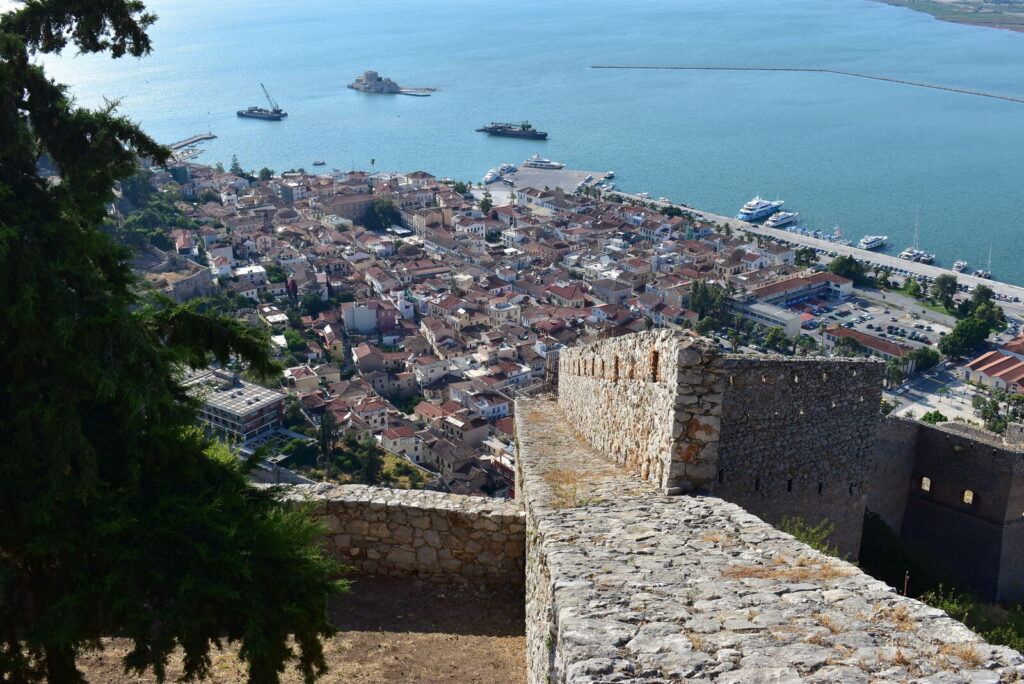
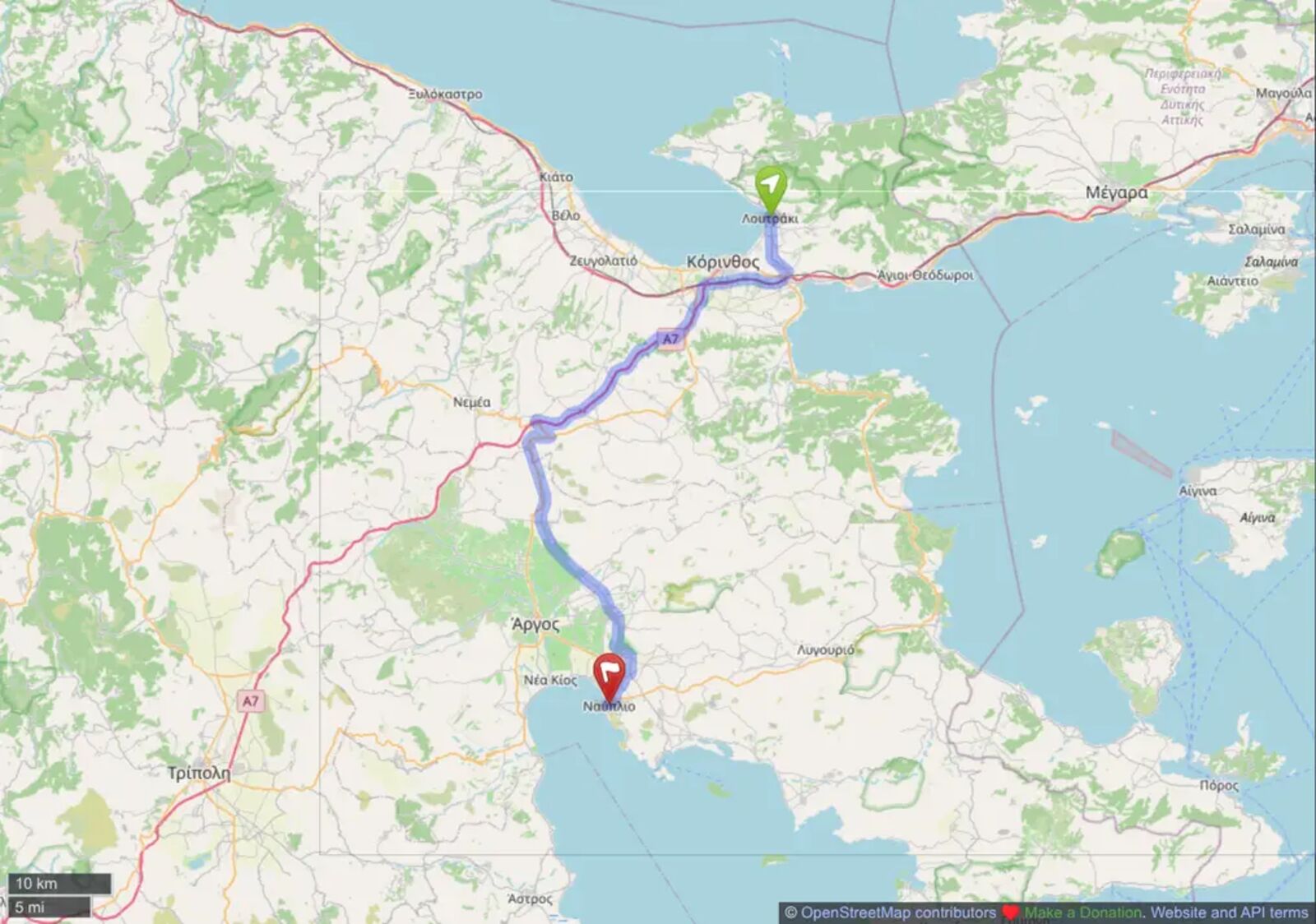
Nafplio is the town most people picture when they think of a Greek harbour: Venetian walls, a fortress on the hill above and a tiny castle sitting in the bay. It’s also about 71 km from Loutraki by our own route calculation, an hour and ten minutes or so by car, which makes it one of the easier big day trips from here. What most guides skip is the small print. Two of the best-known claims about Nafplio don’t hold up as usually told, and the beaches everyone calls Blue Flag aren’t on the official 2026 list.
This guide is written for a self-drive day out from Loutraki, with official ticket prices and opening hours checked on 21 November 2026. For shorter outings closer to the villas, see our round-up of things to do around Loutraki.
Nafplio in a day: what fits and what doesn’t
Nafplio has three separate fortresses, not one. Palamidi crowns the hill, Bourtzi sits on its islet in the harbour, and Akronafplia is the lower, older rock between the two. Each has its own access and history, and Palamidi and Bourtzi have their own tickets. Add the old town and the Archaeological Museum, and a single day fills quickly.
A realistic plan from Loutraki: leave after breakfast, do Palamidi first while it’s cooler, have lunch in the old town, then choose Bourtzi, the museum or a swim for the afternoon. Doing all of it plus Mycenae or Epidaurus is possible on paper and rarely enjoyable in July. Two things done properly beat five in a rush.
Winter hours are shorter. Palamidi’s official winter opening runs 08:30–15:30, so in the cooler months the fortress has to come first or not at all.
Palamidi: eight bastions on one hill
Palamidi stands on a hill about 216 metres above the sea, and it’s younger than it looks. The Venetians built it between 1711 and roughly 1714, in their second period of rule in the Peloponnese, to designs usually credited to the engineers Antonio Giancix and Pierre de la Salle. It didn’t stay Venetian for long. The Ottomans took it in 1715, barely finished, and held it until the night of 29 November 1822, when Greek fighters under Staikos Staikopoulos captured it in a surprise attack.
Instead of a single keep, Palamidi is eight self-contained bastions, each able to hold out if its neighbours fell. Most are named after heroes of ancient Greece, Themistokles and Leonidas among them. The chapel of Agios Andreas inside the central bastion was built in 1712 and originally dedicated to Agios Gerardos, patron saint of the Sagredo family, whose member governed the area for Venice. The Miltiades bastion later became a prison, and the Ministry of Culture notes that Theodoros Kolokotronis, the best-known general of the War of Independence, was held there.
Tickets, according to the Ministry of Culture’s Palamidi page, are €20 full and €10 reduced; from 1 June to 30 September only the full ticket is sold. Entry is free on a handful of fixed dates, including 6 March, 18 April, 18 May and 28 October, and on the first and third Sunday of each month from November to March. Summer hours run as late as 20:00. There’s little shade on the walls. Carry water.
The 999 steps, and why nobody can give you the real number
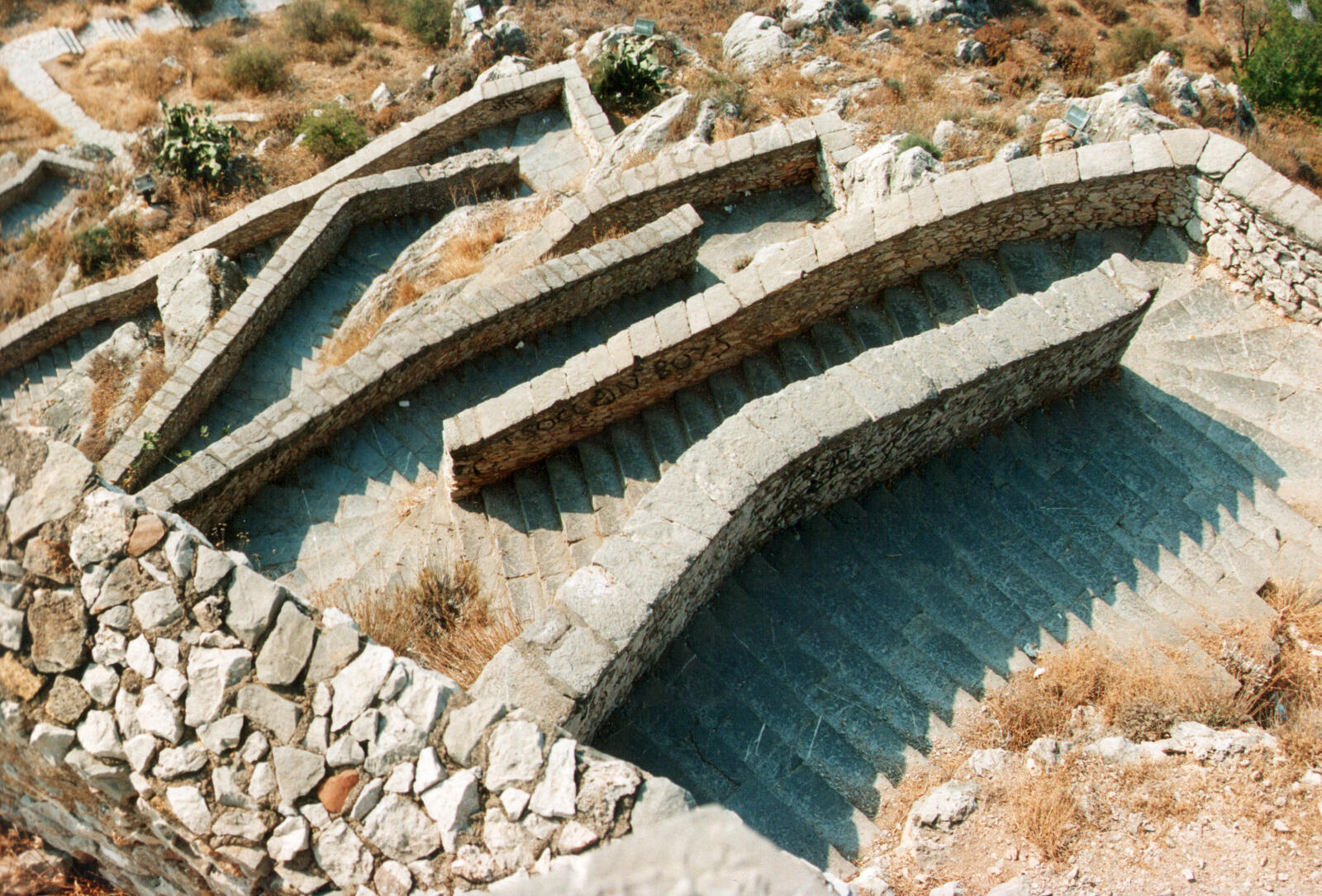
Almost every guide repeats that 999 steps lead up to Palamidi. It’s a good story. It isn’t an official figure, though: we couldn’t find a Ministry of Culture or municipal page that gives a count at all. People who have actually counted usually come out somewhere between about 850 and 900, and one widely quoted count is 857. Even the University of the Peloponnese treats it as an open question on its Nafplio page, asking whether it’s 999 or 857 and suggesting you find out for yourself.
Whatever the exact number, the climb is steep, stone and exposed, and the steps are uneven in places. If anyone in your group isn’t up to it, there’s another way: a road winds round the gentler eastern side of the hill to a car park by the upper gate. What doesn’t exist is a cable car, despite a steady trickle of searches for one. Stairs or road: that’s the choice.
Bourtzi: the castle you reach by boat
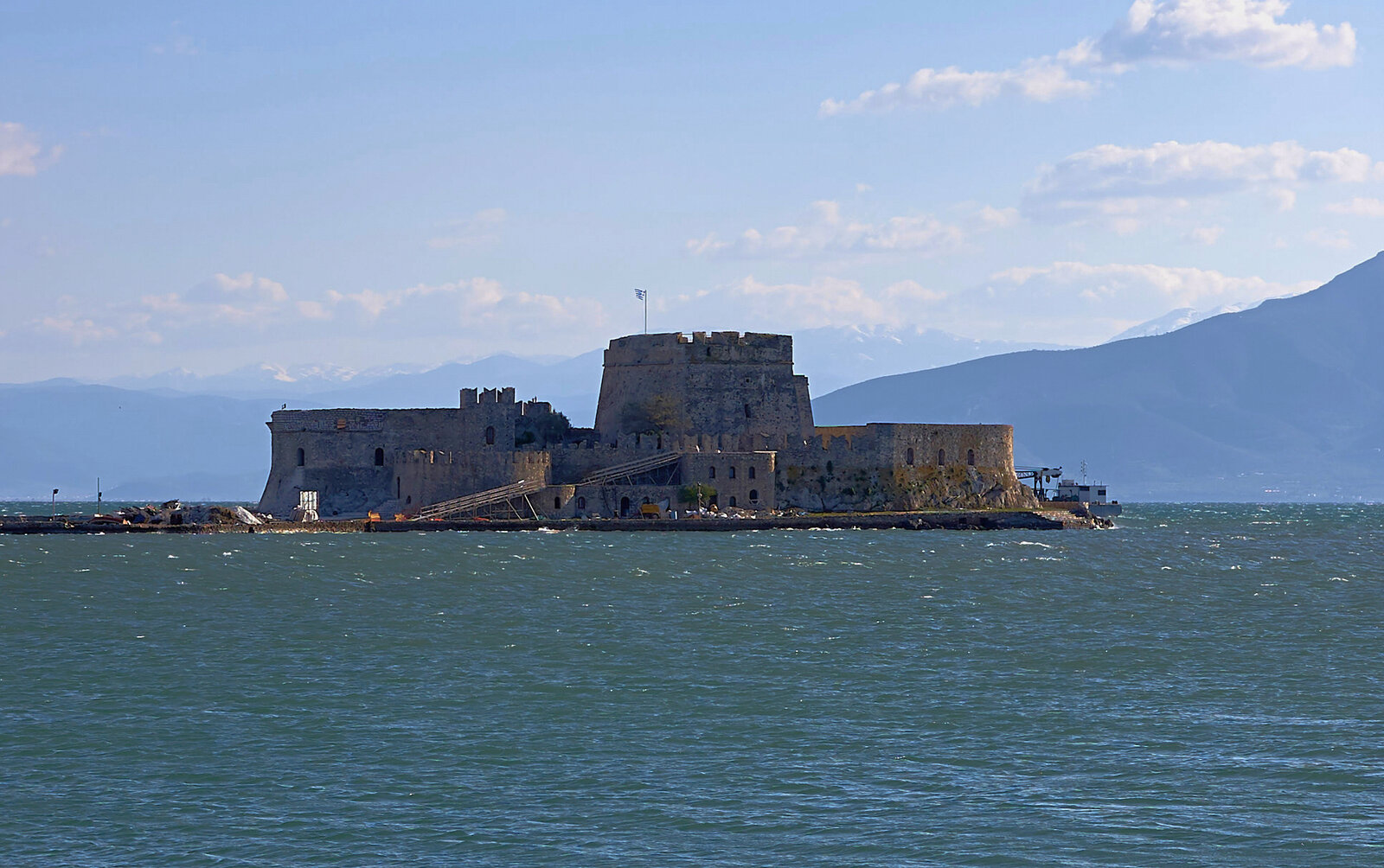
Bourtzi is the small fortress on the islet at the harbour mouth, and it’s older than Palamidi by more than two centuries. According to the fortress’s own history page, written by an architect of the local Ephorate of Antiquities, building started in June 1471 under the Venetian architect Antonio Gambello. The Venetians called it Castel Pasqualigo, or the castle of the rock; the name Bourtzi, meaning tower, only arrived with the Ottomans. An iron chain once ran from the islet to a bastion on shore and could be raised to close the harbour to shipping.
Its later history is odder. After 1833 it housed the state executioner, who left the island only to carry out sentences at Palamidi. From the early 1930s it was let to the Greek tourism organisation and run as a 14-room hotel and restaurant for around 37 years, hosting international guests in the 1940s and 1950s. A restoration by the Ministry of Culture was completed in 2021, and the fortress now has exhibition spaces.
Access is by boat from the harbour, for a separate fee. Admission is €7 full and €5 reduced on its Ministry of Culture listing, and in November and December it’s open daily 09:00–17:00, with longer hours in summer. Boat times and fares aren’t published alongside, so check at the quay before you plan around them.
Akronafplia, the fortress most day-trippers walk past
Akronafplia is the rocky headland between the old town and Palamidi, and it’s the oldest fortified part of the city. The Ephorate of Antiquities dates its first walls, built of polygonal stone, to the end of the 4th century BC, and parts of them still form the base of later masonry. The Franks later split it in two with a partition wall, one castle for their own officers and one for the Greeks, and the Venetians fortified its eastern end after 1470.
Two details explain why it doesn’t feel like a ruin. In 1713 the Venetians cut the Sagredo Gate into its north wall to give troops a direct route up from the lower town. And between 1950 and 1975 the rock was developed for tourism, with two hotels built on it in 1961 and 1971. It’s worth a slow walk along its edge on the way to Arvanitia, but don’t expect a ticketed site in the way Palamidi is.
The old town, Syntagma Square and the museum
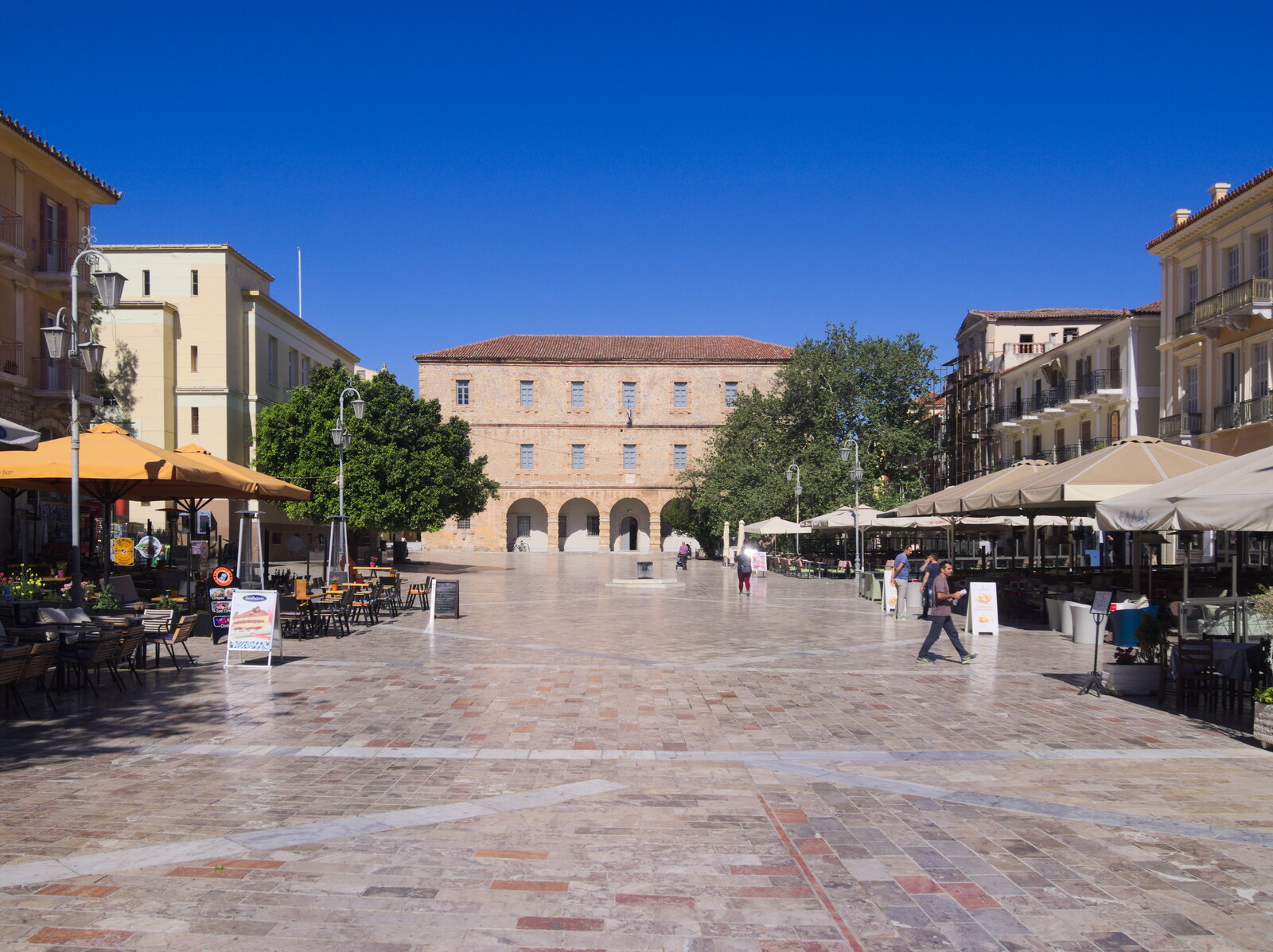
The old town is compact. Walk it. Park near the harbour, and you’re a few minutes from Syntagma Square, the paved square at its centre. Its most striking building is the two-storey former Venetian naval warehouse of 1713, which now houses the Archaeological Museum of Nafplio.
The museum’s ticket is €10 full and €5 reduced, with the same summer full-price rule as Palamidi, and the museum’s official page states that it’s closed every Tuesday. Easy to miss. Elsewhere in the old town, the church of Agios Spyridon is where Ioannis Kapodistrias, the first governor of independent Greece, was assassinated by Konstantinos and Georgios Mavromichalis in 1831. You’ll see the date given as 27 September or 9 October; they’re the same day, under the old Julian calendar and the modern Gregorian one.
“The first capital of Greece”: true, with an asterisk
Nafplio is routinely called the first capital of modern Greece, and that’s only half the story. Kapodistrias first set foot on the Greek mainland at Nafplio in January 1828, but his government worked from the island of Aegina, which served as the temporary capital until October 1829. Nafplio then took over and stayed the capital until King Otto moved it to Athens in 1834.
So Nafplio was the capital of the new kingdom, and the town where its first governor was killed. Aegina came first. Even the dates you’ll see for Nafplio vary: Wikipedia gives 1829 for official capital status, while the municipality’s own history project uses 1827 to 1834. Both count from a different starting point.
Arvanitia, Karathona and the Blue Flag question
Arvanitia is the town beach, a pebble shore below the Akronafplia cliffs and about ten minutes on foot from Syntagma Square by our map. Karathona is the larger sandy beach behind Palamidi hill, roughly 3 to 4 km from the old town by road.
Plenty of guides describe both as Blue Flag beaches. They aren’t on the official 2026 Blue Flag list for Greece: in the whole of Nafplio municipality, only Kondyli and Plaka hold the award this year. That doesn’t make either beach dirty; the flag also depends on lifeguards and safety criteria. Just don’t choose them for the label. For comparison, Loutraki’s own town beaches, Loutraki 1 and Loutraki 2, are on the same 2026 list, and our guide to beaches near Loutraki covers them.
Adding Mycenae or Epidaurus to the day
Nafplio is a handy stop for two of the region’s biggest sites. By our own routing, Mycenae is about 25 km from Nafplio, around half an hour, and the Ancient Theatre of Epidaurus is about 27.5 km, around 40 minutes. That’s markedly shorter than driving to Epidaurus directly from Loutraki, which takes about an hour and a half, so if you want both in one outing, Nafplio is the natural stop between them. Our guide to Epidaurus covers its ticket and the theatre itself.
Mycenae is also easy to reach on its own: about 51 km and under an hour from Loutraki, and our guide to Mycenae covers the Lion Gate and the Treasury of Atreus. Pick one to pair with Nafplio. Not both. On the way down you’ll pass close to the Corinth Canal, which is worth a ten-minute stop if you haven’t seen it yet.
What we won’t tell you
Some numbers are missing on purpose. We haven’t given a step count for Palamidi because nobody official publishes one. We haven’t quoted boat fares to Bourtzi, because they aren’t listed with the fortress’s opening hours. We haven’t given bus times either: KTEL Argolida’s own timetable pages wouldn’t load when we checked, so we can’t vouch for them, and for this trip a car is the practical option. And we haven’t listed exhibits at the Archaeological Museum, since we couldn’t confirm the current display from the museum’s own pages. If you’re coming from Athens rather than from the villas, our Athens to Loutraki guide covers the first leg.
Base yourself in Loutraki
Staying in Loutraki puts Nafplio, Mycenae and Epidaurus all within day-trip range, with the sea and the spa town to come back to in the evening. Villa Elena has nine bedrooms for up to 25 guests, a private pool and a floodlit tennis court, which suits larger family groups splitting into two cars for the day. Villa Aura is a 14-room bed-and-breakfast around 50 metres from the sea in Skaloma. Tell us your dates through the enquiry form, and we’ll come back with availability and a direct quote.
Ticket prices, opening hours and free-admission dates are taken from the Ministry of Culture’s own pages (odysseus.culture.gr), Bourtzi’s history from the fortress’s official site, and the Blue Flag status from the official 2026 list at blueflag.gr, all checked on 21 November 2026. Distances and drive times are our own calculations with OpenStreetMap routing. Prices and hours change, so please check the official pages before you travel. Cover photo: view from Palamidi over Nafplio and Bourtzi by Annatsach, CC BY-SA 4.0, via Wikimedia Commons.
Frequently asked questions
How far is Nafplio from Loutraki?
Our own route calculation puts it at about 71 km, or roughly an hour and ten minutes by car, via the A7 motorway past Corinth and then Argos. Allow longer in summer traffic and for parking near the harbour.
Are there really 999 steps up to Palamidi?
Probably not. The figure of 999 is a local tradition rather than an official count, and no Ministry of Culture or municipal page publishes a number. Visitors who have counted usually report somewhere between about 850 and 900, and the University of the Peloponnese asks whether it’s 999 or 857.
Is there a cable car to Palamidi?
No. There are two ways up: the stone stairway from the old town, or the road around the gentler eastern side of the hill to a car park near the upper gate.
Is Nafplio really the first capital of Greece?
Partly. Nafplio was the capital of the new Greek state until King Otto moved it to Athens in 1834, but Governor Kapodistrias’s government worked from the island of Aegina until 1829, so Aegina has a fair claim to have come first.
Are Arvanitia and Karathona Blue Flag beaches?
Not in 2026. Many guides still describe them that way, but the official 2026 Blue Flag list for Nafplio municipality names only Kondyli and Plaka. Loutraki’s own town beaches, Loutraki 1 and Loutraki 2, are on the same list.
