
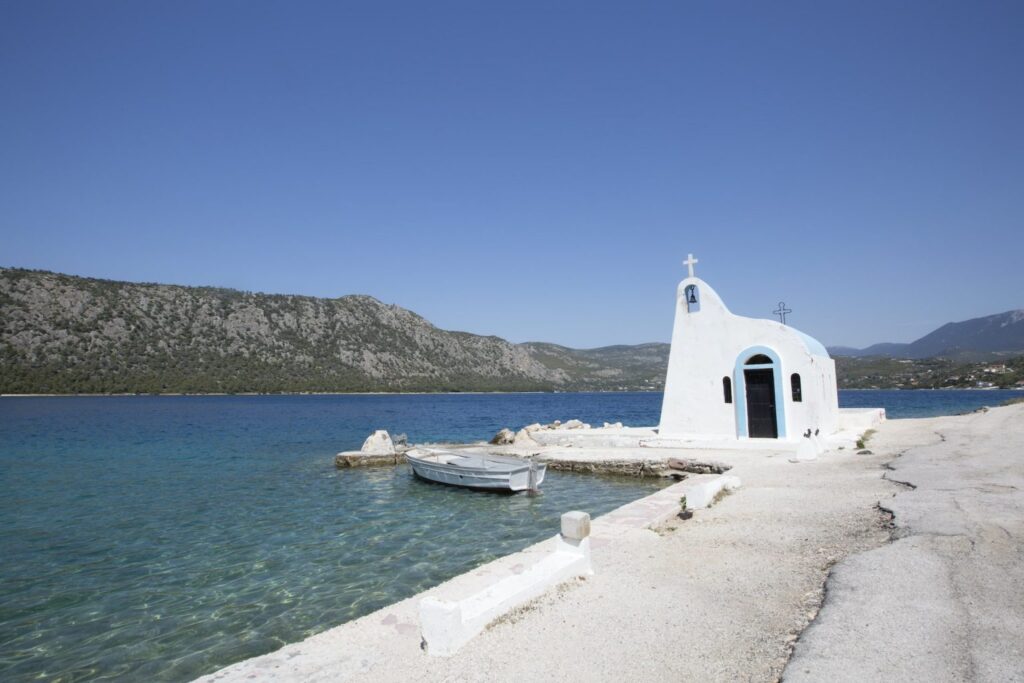
Loutraki is a seaside spa town in Corinthia, on the Gulf of Corinth in the Peloponnese, just north of the Corinth Canal and about an hour’s drive from Athens. It has been a recognised spa destination since 1925, and most first-time visitors come for the thermal springs, the casino, or a beach base close to ancient Corinth. This guide is the hub for the rest: where Loutraki sits, what the spa and casino are actually like, and when to go. For transport, beaches and day trips, we link to the dedicated posts below rather than repeat them here.
Where is Loutraki, and why base yourself here?
Loutraki sits on the northern shore of the Gulf of Corinth, at the foot of the Geraneia mountains, in the regional unit of Corinthia. It’s the seat of the Loutraki–Perachora–Agioi Theodoroi municipality and lies a few kilometres north of the Corinth Canal, the 19th-century waterway separating the Peloponnese from mainland Greece. That position is really the whole pitch: a working seafront town with cafés and a promenade, a short drive from a genuinely major ancient site, and (unusually for a beach town this close to Athens) a spa culture that keeps things open year-round rather than shutting down after September.
It isn’t trying to be a Cycladic island, and it shouldn’t be judged as one. Think of it more as a low-key Greek provincial town with a coastline attached, which is why it works better as a base for exploring Corinthia than a standalone bucket-list stop. For a realistic itinerary, see our guide to things to do in Loutraki; for every transport option, see getting from Athens to Loutraki.
The thermal springs and spa of Loutraki
Loutraki takes its name from its thermal springs (loutra means baths in Greek), and the town has been used for therapeutic bathing since antiquity, when the settlement here was known as Thermae. You can taste the water for free at the small spring outlet in the town’s central park, marked Ιαματικόν (Therapeutic); it has a mineral tang that takes some people a second sip to like.
The water itself is officially characterised as a moderately hydrosulphide (sulphur-bearing), sodium-chloride, magnesium thermal water that is weakly radioactive, drawn from source at 33°C. According to the operator’s published technical data it carries an average radon content of 71.6 Bq/l and radium around 0.2 Bq/l, figures that sound alarming out of context but sit within the range typical of European thermal spas. The listed indications are musculoskeletal, nervous-system and skin conditions, with contraindications including pregnancy, recent cardiac events and active cancer, so it’s worth checking those before booking treatments rather than at the door (source: Loutraki Thermal Spa, therapeutic water properties).
The modern Loutraki Thermal Spa uses this same water in two indoor heated pools with hydro-massage jets, plus a treatment menu. It’s open year-round, including weekends and public holidays, and use of the facilities requires guests to be at least 15. This is a spa built for adults and older teenagers, not toddlers. Sample prices from the operator’s 2025 official price list: 20 minutes of pool hydromassage runs €13, a 30-minute sauna session €13, a 45-minute full-body massage €50. These are 2025 figures, the most recent published, so check the current PDF before booking (official 2025 price list, PDF).
In practice, most guests treat the spa as a half-day add-on (a couple of hours after a morning at the beach, or a wet-weather backup) rather than the centrepiece of a trip.
Visiting the Club Hotel Casino Loutraki
The Club Hotel Casino Loutraki is Loutraki’s best-known evening attraction, and it’s worth knowing the rules before you turn up. Entry is free, with no cover charge, but you must be 21 or over and bring a valid passport (Greek citizens can use an ID card or EU driving licence). Swimwear and flip-flops aren’t permitted, and shorts are only allowed until 18:00. Slot machines run 24 hours a day, table games operate 14:00–04:00, Ultimate Texas from 16:00, and the Poker Arena runs 18:00–05:00 (official access and dress-code page). We’re not quoting numbers of machines or tables here: the operator doesn’t publish an authoritative figure for either.
When is the best time to visit Loutraki?
Late spring to early autumn (roughly May to October) is when the Gulf of Corinth is warm enough for swimming and the beaches, tavernas and casino are all running at full pace. July and August are the busiest and hottest months. The nearest official climate data comes from the meteorological station at Perigiali in Corinthia: the multi-year August average is 28.7°C, with an average daily maximum of 33.0°C and average minimum of 24.5°C, based on records from 2007–2024 (meteo.gr, National Observatory of Athens). We couldn’t find an official month-by-month breakdown for this station, or a published sea-temperature dataset for Loutraki, so we won’t invent one. Expect a typical Gulf of Corinth swimming season, roughly late May through October.
How many days do you need, and where to look next
Two to three days covers the essentials comfortably: one for the beaches and thermal spa, one or two more for day trips into Corinthia. Some visitors do Loutraki as a day trip from Athens instead, which is entirely workable given the drive time, though it means skipping the evening spa or casino sessions.
- Transport options (car, KTEL bus, train, airport transfer): Athens to Loutraki.
- Corinth Canal, Zulu Bungy, Ancient Corinth, Acrocorinth, the Monastery of Osios Patapios: things to do in Loutraki.
- Beach-by-beach detail, including Lake Vouliagmeni and current Blue Flag status: best beaches in Loutraki.
- Villa versus hotel for a group trip: villa holidays in Greece.
Who Loutraki isn’t for
Worth being upfront about this. If what you actually want is white sand, turquoise water and island nightlife, Loutraki will disappoint: the beaches are pebble, the town is a working provincial centre rather than a resort, and there’s no island-hopping feel. It’s also not the right pick if late-night clubbing is the point of the trip; the casino and a handful of bars cover evenings, but it’s quieter than Mykonos or central Athens. Where it delivers is as a comfortable base for a mix of spa time, an easy beach, and real archaeological sites without a long transfer each day.
Where to stay in Loutraki ranges from seafront hotels to private villas with pools. Loutraki Villas Collection manages hand-picked properties in and around the town, including the hilltop Villa Elena (nine bedrooms, a private pool and a lit tennis court, and space for up to 25 guests for events) and the beachfront Villa Aura, a 14-room bed-and-breakfast around 50 metres from the sea in Skaloma. You can compare all of our villas in Loutraki, and nearby locations in Porto Germeno and Porto Rafti, directly, with no platform fees.
Spa treatment prices from the 2025 official price list, the Club Hotel Casino Loutraki entry rules and the Perigiali climate averages were checked in August 2026 and can change; the linked official pages are the authority.
Frequently asked questions about Loutraki
How far is Loutraki from Athens, and how do I get there?
It’s roughly an hour’s drive on the Olympia Odos motorway, though traffic out of Athens can add extra time on a Friday afternoon. We’ve put every transport option (car, bus, train, airport transfer) with current timetable links in our dedicated Athens to Loutraki guide rather than duplicate it here.
Is Loutraki worth visiting?
It’s worth it if you want a relaxed spa town with a real beach and easy access to Ancient Corinth, the Corinth Canal and the Heraion of Perachora. It’s less of a fit if you’re after an island-style holiday. Most people who enjoy it are combining a beach day with the thermal springs and at least one day trip.
What is Loutraki known for?
Its natural thermal springs and bottled mineral water first, then the Club Hotel Casino Loutraki and its role as a gateway to the Corinth Canal and Ancient Corinth. It’s also known locally for the “35 consecutive years” Blue Flag distinction awarded to its Loutraki 1 beach in 2026 (see our beaches guide for the current list).
Do I need a car in Loutraki?
Not for the town itself: the seafront, spa and shops are walkable. You’ll want a car or a booked transfer for the Corinth Canal, Ancient Corinth, Lake Vouliagmeni and the Heraion of Perachora, all of which sit a short drive outside town; our things to do guide covers distances for each.
Ready to see it for yourself? Browse our private villas in Loutraki and send an enquiry for live availability. Our concierge team can help with spa bookings, transfers and day trips across Corinthia.
